
The short version on sharks in San Francisco Bay
For Alcatraz and other San Francisco Bay swimmers, sharks belong low on the risk list. White sharks are the one shark in California waters with a meaningful history of serious bites on people, so they are the only shark this article is really about. Adult white sharks live and hunt mainly along the outer coast and near offshore seal colonies, and they only rarely enter San Francisco Bay.
White sharks are real in Northern California. A small number of tagged white sharks have been recorded passing through the Golden Gate, and a few sightings inside the Bay have been documented. But to our knowledge, and based on the available public record, there is no confirmed white shark bite on a swimmer inside San Francisco Bay across generations of organized events, club swims, guided crossings, training swims, and recreational open water swimming.
That does not make the Bay risk free. It means the shark fear is badly out of proportion to the risks swimmers should actually prepare for. In our experience, a swimmer’s preparation, ability, endurance, situational awareness, and judgment matter most here, because they are tested in cold water, current, fatigue, navigation, vessel traffic, limited visibility, and changing conditions.
Why we are writing only about white sharks
A few species of small shark share San Francisco Bay. None has a credible record of injuring an open water swimmer here. They are not what people are afraid of, so they are not what this article is about.
The fear, when people have it, is about one animal: the great white shark. In California, fatal shark incidents in the modern record have likely involved white sharks. When someone pictures a shark under their feet in the Bay, this is the animal they are picturing.
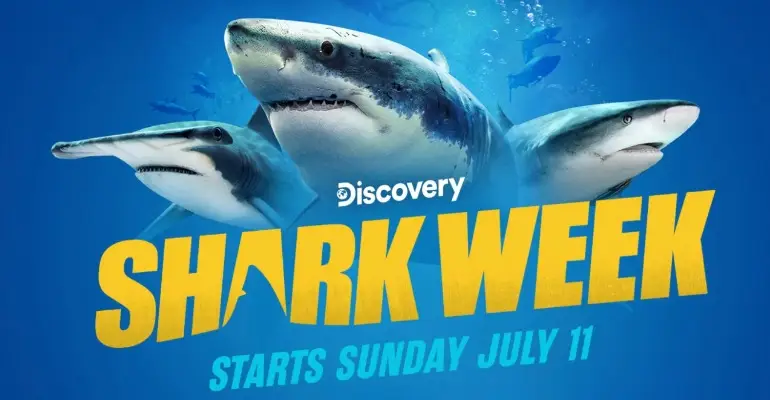
So rather than catalog the Bay’s smaller shark species and pretend that answers the real question, we want to be precise about the species swimmers are actually asking about, show where adult white sharks are most often found, and explain why San Francisco Bay is, by all available accounts, rarely where they feed.
Two decades swimming and piloting San Francisco Bay
We have swum and piloted these waters for more than two decades. We have been members at the South End Rowing Club, founded in 1873, and the Dolphin Club, founded in 1877. Between our operations at Pacific Open Water Swim Co. and SwimAlcatraz.com, we log thousands of hours on the water each year escorting swimmers from around the world in these waters.
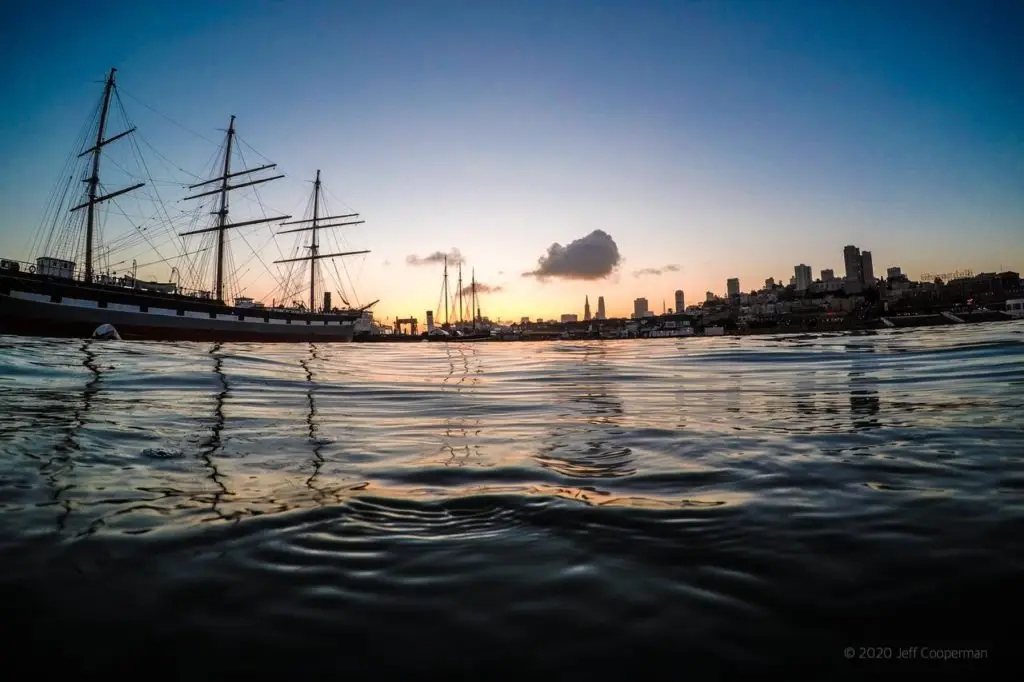
In that time, across our own swims and the accounts of longtime Bay swimmers who have been in the water nearly every day for decades, we are not aware of a single confirmed white shark encounter with a swimmer inside the Golden Gate. No fins. No bumps. No close calls. That is not a promise about the future. It is an honest account of the record as we know it.
What sharks actually live in San Francisco Bay
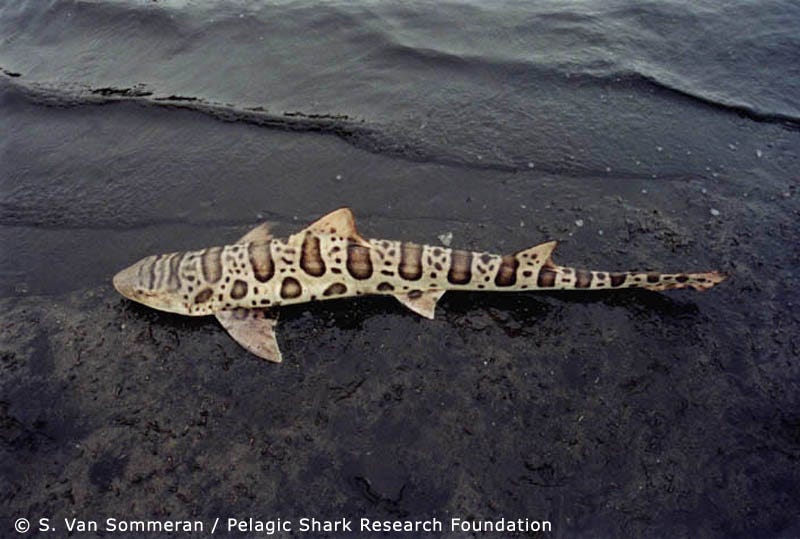
Almost every shark species in San Francisco Bay is a small, bottom feeding fish that spends its life nosing through the mud and sand for crabs, shrimp, worms, clams, and small fish. They primarily keep to the bottom. They are rarely seen unless someone fishing pulls one up, though leopard sharks and other Bay species may occasionally be seen near the surface or jumping. We are not aware of any documented record of these species injuring an open water swimmer here.
The common shark species found here include leopard sharks, brown smoothhounds, gray smoothhounds, spiny dogfish, Pacific angel sharks, and soupfin sharks, also called tope. These animals feed mostly on small fish, crabs, shrimp, worms, clams, squid, and other bottom associated prey. They are part of the Bay’s ecosystem. They are not the shark risk people are usually asking about.
The broadnose sevengill: the Bay’s one true predator
The one shark in the Bay that is a genuine predator rather than a bottom forager is the broadnose sevengill. We mention it so the picture is complete. It can reach roughly eight feet, and San Francisco Bay is one of the few known nursery grounds for the species in the world. Sevengills keep to the bottom around the Golden Gate and Alcatraz, mostly in summer. Documented sevengill bites on swimmers are effectively nonexistent that we have been able to find. They have shared this water with daily swimmers for generations with no known record of trouble.
None of these species changes the practical safety picture for an Alcatraz swim or other guided Bay swim. The sharks commonly found in the Bay have no known record of harming open water swimmers here.
Where white sharks actually are near San Francisco
White sharks are present along the central California coast. The point is that the coast and the Bay are not the same place. That difference is worth picturing if you have never stood at the Golden Gate.
The open Pacific begins outside the Golden Gate. For navigation purposes, the United States Coast Guard COLREGS demarcation line, drawn from Point Bonita Light through Mile Rocks Light to the shore, marks the transition from US Coast Guard Inland Rules waters to COLREGS waters. San Francisco Bay sits behind the Gate, connected to the ocean by the narrow strait the Golden Gate Bridge spans.
The white shark hotspots sit out on the ocean side, away from the Bay swimming venues. The Farallon Islands lie about twenty nine miles (48km) west of the Golden Gate. Año Nuevo, a major seal and sea lion rookery, is about forty eight miles (77km) down the coast toward Santa Cruz. Point Reyes and Tomales Point are about 25 miles (40km) up the coast to the north. Together, this open coast region is part of what people often call the Red Triangle, and it is where much of California’s white shark activity occurs.
Now picture where people swim. Aquatic Park, the cove between the Dolphin Club and the South End Rowing Club, sits inside the Bay against the San Francisco waterfront, surrounded by city. Alcatraz stands a little over a mile (1.6km) offshore from that waterfront, still inside the Gate. To reach the main swimming venues from the Farallon hunting grounds, a shark would leave the open ocean, cross almost thirty miles (48km) of water, and pass through the Golden Gate into an enclosed, murky, heavily trafficked Bay ringed by San Francisco, Oakland, Berkeley, and Sausalito.
That is a different world from the large offshore seal colonies where adult white sharks feed.
Why white sharks feed offshore, not in the Bay
What’s documented clearly is that adult white sharks concentrate where their food concentrates, which means the pinniped (seal/sea lion) colonies of the outer coast. The Farallon Islands are one of the major white shark hunting grounds on the West Coast, drawing large adults to feed on seals and sea lions. Año Nuevo and other haul outs along the open coast attract them for the same reason.
White sharks are capable predators with complex behavior. But the basic pattern matters for swimmers. The inner Bay is not a major white shark feeding ground. It does not have the same clear water, depth, prey concentration, or outer coast habitat structure that supports regular white shark hunting.
Juvenile white sharks and a changing ocean
Juvenile white sharks tell a different and changing story. Young white sharks use coastal nursery areas, and their range has historically centered farther south, including Southern California and northern Mexico.
That range is moving. During the marine heatwave of 2014 to 2016, researchers documented juvenile white sharks appearing far north of their usual range, with the northern edge shifting from near Santa Barbara to around Bodega Bay as the ocean warmed.
We mention this not to alarm anyone, but because intellectual honesty demands it. The conditions that have kept San Francisco Bay outside the white shark’s normal hunting pattern are not fixed forever. The science is still developing. We would rather say that plainly than pretend the picture is frozen.
This does not change the current practical conclusion for San Francisco Bay swimmers. It does mean responsible operators should keep tracking the science, local sightings, seasonal patterns, and changing ocean conditions, then adjust swimmer briefings, route decisions, or operating practices when the evidence calls for it.
White sharks and the Bay: the actual record
White sharks do, on rare occasions, pass through the Golden Gate. A multiyear tagging effort by Stanford researchers recorded a small number of tagged white sharks entering the Bay, with detections near the city waterfront and Alcatraz before the animals moved back out toward the ocean. These records read as brief transits rather than residency, with no sign of hunting behavior directed at swimmers.
A few sightings have made the news. In 2015, an eight to ten foot white shark was seen feeding on a seal carcass at the surface near the Alcatraz dock. In 2020, a fisherman recorded a white shark just inside the Golden Gate. Both are real. Both are notable. Both are also consistent with an animal that occasionally enters the Bay.
Neither involved a swimmer.
Set against the amount of swimming here, the record is striking. Large numbers of people swim in the Bay every year through clubs, events, training swims, private groups, and guided crossings. Across generations of organized events, club swims, guided crossings, training swims, and recreational open water swimming inside the Golden Gate, we have not been able to find or verify a single confirmed white shark bite on a swimmer, nor a confirmed swimmer encounter with a white shark.
That is the record as we know it. It should not be inflated into a guarantee, and it should not be ignored because the myth is louder.
Sharks inside the Golden Gate versus outside it
The distinction between the Bay and the open coast is not a technicality. It is the whole point.
The one fatal shark bite associated with San Francisco happened outside the Golden Gate. On May 7, 1959, Albert Kogler Jr. was attacked by a white shark while swimming off Baker Beach, on the ocean side of the Gate. The Carnegie Hero Fund account describes the attack as occurring in 27 feet of water, about 150 feet from shore. It remains the only fatal shark bite recorded in the immediate San Francisco area, and it happened in open coastal water rather than inside San Francisco Bay.
There is also a much older and far murkier account from around 1851 that describes some kind of shark encounter near an Alameda cannery. The details are thin and unverifiable in our research. It is not clear that it describes a predatory attack at all rather than an observation, a fishing related event, or a chance interaction. We include it for completeness and treat it as the unsourced anecdote it is.
What we will not do is claim certainty the record cannot support. We cannot prove a negative. We can tell you that the documented serious incidents sit on the ocean side of the Gate, that the Bay’s record is clean as far as the available evidence shows, and that this pattern fits what is known about where adult white sharks usually hunt.
Open coast risk is real
A serious white shark incident in California is rare, but it is not imaginary. The outer coast is different water, with different habitat, different prey, and a different risk profile. Monterey Bay, the San Mateo coast, Point Reyes, Sonoma County, and other exposed coastlines sit in a different category from Aquatic Park, Alcatraz, and the inner Bay.
That distinction matters even more now. Recent fatal and non fatal shark incidents on the California coast have reminded the open water community that white shark risk is real in exposed coastal habitat. Those events should be taken seriously. They should also be understood in the right geography.
This article is about San Francisco Bay inside the Golden Gate. It is not a claim that all Northern California open water carries the same shark risk. It does not.
What the San Francisco Bay shark hype gets wrong
The shark infested Bay idea is older than the modern open water community. Alcatraz guards reportedly encouraged the legend to discourage prisoners from attempting to swim to shore, and decades of television and film turned a prison rumor into received wisdom.
It makes a good story. It does not survive contact with the evidence.
California sees only a small number of shark incidents in a typical year across its entire coastline, which runs roughly 840 miles (1,350km). Serious incidents are rarer still. Inside San Francisco Bay, the issues that deserve the most attention usually begin with swimmer preparation, ability, endurance, situational awareness, and judgment in cold water, current, limited visibility, vessel traffic, and changing conditions.
That framing matters. Cold water is not the actor. Current is not the actor. The Bay is not the villain. Those are the conditions. The swimmer brings preparation, ability, endurance, situational awareness, and judgment into those conditions, and that is where most problems begin or get avoided.
A swimmer who spends all week worrying about sharks and no time practicing sighting has prepared for the wrong problem. A swimmer who fears the shadow below but overstates their experience, ignores pace, fights the current, or fails to communicate with the escort has missed the actual risk profile of the Bay.
The wildlife you might see in San Francisco Bay
The Bay is full of life, and many swims include an encounter with something.
That something often includes harbor porpoises, which move through in small groups, and their return in recent years is a good sign for the health of the water. Bottlenose dolphins appear occasionally in pods. Harbor seals and California sea lions are a near daily presence and usually keep their distance. Gray whales and humpbacks pass through in spring and fall on their migrations between Mexico and Alaska, sometimes close enough to stop everyone on our escort vessels and enjoy the enchanted encounters close up.
We will not tell you these animals are perfectly predictable. They are wild, and wild behavior carries uncertainty. What we can say is that across thousands of swims, serious marine animal interactions are rare, and the animals that share the Bay generally want nothing to do with us.
Sea Lions: The Rare Close Call
If any marine animal in the Bay has actually injured swimmers in recent memory, it is the California sea lion, not a shark. Honesty requires us to say so.
The clearest documented local case is a cluster of bites at Aquatic Park Cove over the winter of 2017 and 2018, serious enough that the cove was briefly closed to swimmers and the injuries were later written up in the medical literature. Researchers discussed possible causes including illness, stress, habituation to people, and domoic acid poisoning from harmful algae, which can affect a sea lion’s brain and behavior.
California has seen further episodes of unusually aggressive sea lion behavior tied to algae blooms in the years since. These episodes are uncommon and often involve animals that are sick, stressed, or behaving abnormally.

Most swimmers who see seals or sea lions experience brief, non aggressive encounters. Sometimes the animals remain well away. Sometimes they surface nearby, follow briefly, or cross a swimmer’s line before there is much room to react. If one approaches, the guidance is simple. Stay calm. Create space where possible. Do not chase, touch, feed, corner, or interact with the animal. Signal your escort if you have one. In a guided swim, our captains monitor marine mammal activity and may reposition vessels or swimmers when conditions allow to increase separation and reduce the chance of a close encounter.
Frequently asked questions about sharks in San Francisco Bay
Are there sharks in San Francisco Bay?
Yes. San Francisco Bay is home to several small, mostly bottom-feeding shark species, including leopard sharks, brown and gray smoothhounds, spiny dogfish, Pacific angel sharks, soupfin sharks, and the larger broadnose sevengill. To our knowledge, none of these species has a documented record of injuring an open water swimmer inside the Bay. White sharks, the species people usually worry about, are only rarely recorded inside the Golden Gate.
Have there been shark attacks on swimmers in San Francisco Bay?
Based on the available public record and our experience on these waters, we have not been able to find or verify a confirmed white shark bite on a swimmer inside San Francisco Bay. This is an honest account of the record as we understand it, not a guarantee about the future. The absence of a documented incident does not prove that one cannot occur.
Is it safe to swim from Alcatraz?
Many people swim from Alcatraz every year, and in our experience sharks rank low on the list of relevant risks for a Bay swim. That is not a promise of safety. Open water swimming carries real and inherent risks, including cold water, current, fatigue, limited visibility, and vessel traffic, and each swimmer is responsible for honestly assessing their own fitness, preparation, and readiness before entering the water.
Do great white sharks come into San Francisco Bay?
On rare occasions, yes. A small number of tagged white sharks have been recorded passing through the Golden Gate, and a few sightings have been documented near the waterfront and Alcatraz. These records read as brief transits rather than residency or hunting behavior directed at swimmers. Adult white sharks concentrate where their prey does, mainly along the outer coast near offshore seal colonies, which is a different environment from the inner Bay.
What is the most realistic risk for San Francisco Bay swimmers?
In our experience, the factors that matter most inside the Golden Gate are swimmer preparation, ability, endurance, situational awareness, and judgment, tested against cold water, current, fatigue, navigation, vessel traffic, and changing conditions. Shark fear tends to be out of proportion to these more relevant considerations. This is general information, not safety, medical, or legal advice, and it does not replace any briefing, waiver, or qualified professional guidance.
Shark risk in perspective for Bay and Alcatraz swimmers
Open water swimming carries real and inherent risk. We will never tell you otherwise.
The honest way to frame the shark question is by comparison to the actual operating environment. In San Francisco Bay, the problems that most often matter begin with swimmer readiness and decision making. Cold water, current, fatigue, limited visibility, vessel traffic, and changing conditions test those things quickly.
That does not make white sharks irrelevant as animals. It makes shark fear a poor guide for swimmer preparation inside the Gate.
Preparation comes first. Ability matters. Endurance matters. Situational awareness matters. Judgment matters. The Bay reveals all of it.
How we operate guided Alcatraz and San Francisco Bay swims
Pacific Open Water Swim Co. treats safety as the foundation of everything we operate. Before registration and before each swim, we review the information swimmers provide, along with the planned route, weather, tide, current, vessel traffic, water conditions, and available support options. Based on that information, we determine whether the course and conditions appear appropriate for the swimmer’s stated level of experience and for the operation as planned.
How we assess conditions during a Bay swim
That assessment continues on the water. Conditions can change, and a swimmer’s actual ability, pace, endurance, navigation, comfort, and decision making may become clearer only after the swim begins. When that happens, we revise the plan, adjust the route, reposition swimmers, provide additional support, or end participation when needed.
Each swimmer remains responsible for accurately representing their experience, fitness, health, preparation, pace, and ability before entering the water. Our decisions rely in part on that information, and no pre swim review can verify everything a swimmer knows, omits, misunderstands, or discovers once exposed to cold water, current, fatigue, and open water conditions.
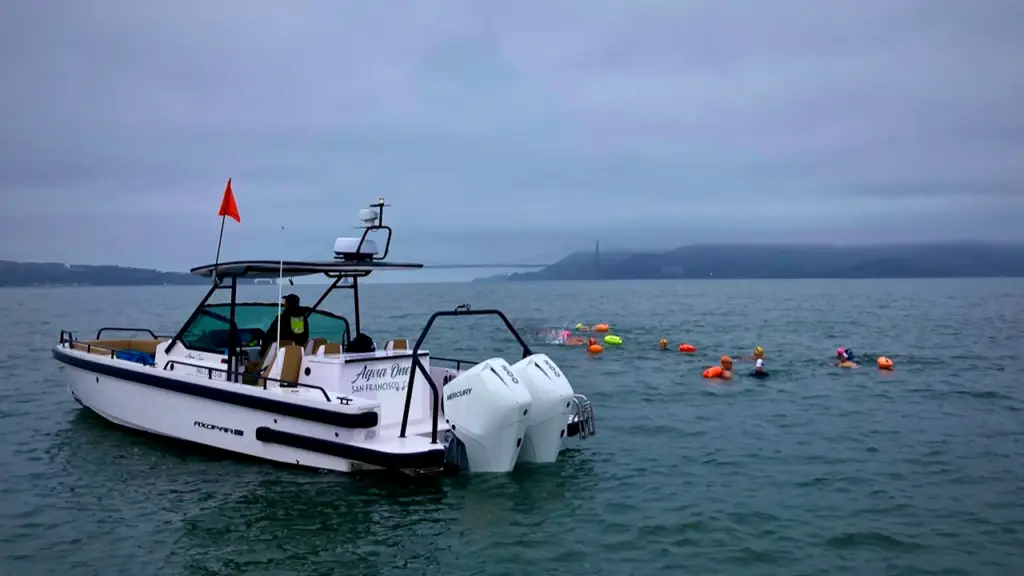
Swimmers are briefed on protocols, the route, the wildlife they may see, and how to respond to a close encounter. Our United States Coast Guard licensed captains operate custom escort vessels close to pace matched swimmers and coordinate as needed with local maritime authorities.
After more than two decades in these waters and thousands of hours on them each year, our operational experience is deep. We apply industry standard precautions and training to support swimmer safety.
We also believe in telling swimmers the truth, including the limits of what any operator can control. Conditions in the Bay change. Wildlife is wild. Vessel traffic moves. Currents matter. Every swimmer carries responsibility for honestly assessing their own fitness, preparation, awareness, and willingness to accept the inherent risks of open water swimming.
The Bay is still one of the greatest, iconic swimming venues anywhere
For generations, people have swum these waters with confidence and good reason. The risks are real, but they are not the ones the legend sells.
Swim smart. Respect the conditions. Learn to sight. Know your limits. Choose the right support for the swim you are attempting. That is how you join a community that has thrived in this water for generations.
Learn more about swimming Alcatraz at SwimAlcatraz.com , or explore guided San Francisco Bay swims with Pacific Open Water Swim Co. at SwimSF.com.
Disclaimer: This article is for general informational purposes only. It is not safety advice, legal advice, scientific authority, medical advice, marine wildlife guidance, or a guarantee of safety or outcome.
Pacific Open Water Swim Co. has worked to present accurate information from credible sources and from our operational experience on San Francisco Bay. Even so, open water conditions vary. Wildlife behavior cannot be predicted with certainty. Historical records may be incomplete. The absence of a confirmed incident in the available record does not prove that an incident cannot occur in the future.
Open water swimming involves inherent risks arising from participation, swimmer condition, swimmer preparation, swimmer conduct, environmental exposure, vessel operations, wildlife, changing weather, changing currents, limited visibility, and other known and unknown hazards. These risks include, but are not limited to, drowning, cold shock, hypothermia, exhaustion, panic, cardiac events, collision, marine life encounters, injury, illness, and death.
Swimmers are responsible for their own judgment, preparation, fitness, medical readiness, equipment, awareness, and decision to enter or remain in the water. Swimmers are also responsible for accurately representing their experience, ability, health, and readiness before participating.
Nothing in this article replaces any signed waiver, participant agreement, ticket contract, swim rules, safety briefing, captain instruction, or other legal agreement used by Pacific Open Water Swim Co., or any affiliated operation. In the event of any conflict, the signed agreement, required safety briefing, captain instructions, and applicable law control.
Participation in any open water swim requires acceptance of risk. Swimmers should consult qualified professionals about site specific risks, health concerns, training readiness, and local conditions before entering the water.
Sources and notes
- International Shark Attack File, Florida Museum of Natural History, Yearly Worldwide Summary, for broad shark incident data and worldwide shark bite context (https://www.floridamuseum.ufl.edu/shark-attacks/yearly-worldwide-summary/)
- California Department of Fish and Wildlife, White Shark Information, for California shark incident frequency and the role of white sharks in serious and fatal incidents (https://wildlife.ca.gov/Conservation/Marine/White-Shark)
- California Academy of Sciences, Advice Concerning White Sharks, for white shark behavior and public safety context in California waters (https://www.calacademy.org/scientists/advice-concerning-sharks)
- Shark Stewards, Great White Sharks in San Francisco Bay, for tagged white shark detections inside the Bay, documented Bay sightings, and the statement that there is no known white shark attack on humans inside the Bay (https://sharkstewards.org/white-sharks-in-san-francisco-bay/)
- Shark Stewards, Sharks of the San Francisco Bay, for common Bay shark species and general local shark ecology (https://sharkstewards.org/sharks-of-the-san-francisco-bay/)
- Save Our Seas Foundation, Sevengill Sharks in San Francisco Bay, for San Francisco Bay as an important sevengill shark habitat and nursery area (https://saveourseas.com/project/sevengills-sharks-in-san-francisco-bay/)
- California Department of Fish and Wildlife, Broadnose Sevengill Shark, for species background on sevengill sharks in California waters (https://marinespecies.wildlife.ca.gov/broadnose-sevengill-shark/false/)
- Tanaka et al., North Pacific warming shifts the juvenile range of a marine apex predator, Scientific Reports, 2021, for the documented northward shift in juvenile white shark range during ocean warming (https://www.nature.com/articles/s41598-021-82424-9)
- Monterey Bay Aquarium, What does a warming ocean mean for white sharks?, for accessible context on juvenile white sharks, warming water, and range change (https://www.montereybayaquarium.org/about-us/stories/warming-ocean-white-sharks)
- KTVU, Great white shark in San Francisco Bay recorded by fisherman, for a documented modern white shark sighting just inside the Golden Gate (https://www.ktvu.com/news/great-white-shark-in-san-francisco-bay-recorded-by-fisherman)
- Time, Watch a Great White Shark Attack and Devour Prey Near Alcatraz, for the documented 2015 white shark predation event near Alcatraz (https://time.com/4073095/great-white-shark-alcatraz-san-francisco/)
- Carnegie Hero Fund Commission, Shirley Frances O’Neill, for the 1959 Baker Beach fatal shark incident involving Albert Kogler Jr., including the location outside the Bay, water depth, and distance from shore (https://www.carnegiehero.org/hero-search/shirley-frances-oneill/)
- Florida Atlantic University, Triple Threat as Sharks, Beach Nourishment and Murky Waters Collide, for the role of reduced visibility and murky water in mistaken bite conditions, used here to avoid overstating turbidity as protection (https://www.fau.edu/newsdesk/articles/sharks-murky-waters-study)
- Wilderness and Environmental Medicine, Severe Sea Lion Bites in Urban Cold Water Swimmers, for the winter 2017 and 2018 Aquatic Park sea lion bite cluster and medical discussion of possible causes and treatment (https://www.jem-journal.com/article/S0736-4679%2819%2930782-6/abstract)
- Wilderness and Environmental Medicine, Pinniped Bites in Open Water Swimmers, for broader medical context on pinniped bites involving open water swimmers (https://www.sciencedirect.com/science/article/abs/pii/S1080603215002458)
- The Marine Mammal Center, Domoic Acid Toxicosis, for how harmful algal bloom toxins can affect sea lion behavior and health (https://www.marinemammalcenter.org/science-conservation/research-topics/domoic-acid-toxicosis)
- NOAA Fisheries, Marine Life Viewing Guidelines and Distances, for public guidance on maintaining distance from seals and sea lions and avoiding interaction with marine mammals (https://www.fisheries.noaa.gov/topic/marine-life-viewing-guidelines/guidelines-and-distances)
- SFGATE, Coroner confirms California woman was killed in shark attack, for recent open coast context and the distinction between exposed coastal risk and San Francisco Bay inside the Golden Gate (https://www.sfgate.com/bayarea/article/coroner-confirms-calif-woman-killed-shark-attack-21285880.php)
Pacific Open Water Swim Co. also operates SwimAlcatraz.com, focused on Alcatraz swims and other San Francisco Bay routes. Our course catalog includes Alcatraz, Golden Gate Bridge crossings, Bridge to Bridge 10km, Angel Island Circumnavigation, Prison to Prison, marathon routes, ultramarathon swim training, qualifying swims, private and social swims, custom courses, solo swims, and pace matched small group swims.