
Round Trip Angel Island Marathon Swim in San Francisco Bay
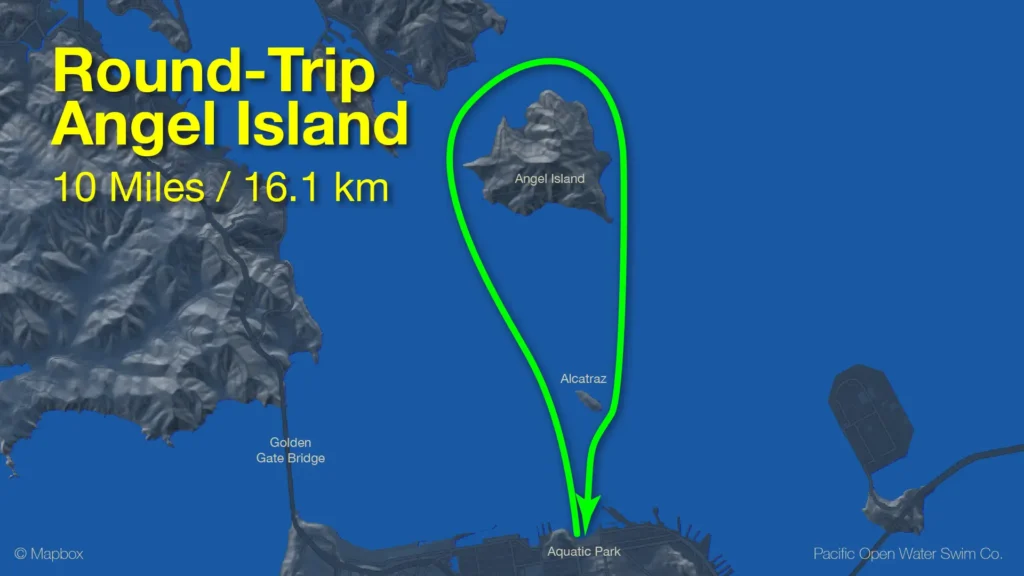
Round Trip Angel Island is a demanding marathon swim in the center of San Francisco Bay and one of the most technical open water routes in Northern California. The route is about 10 miles, 16.1 km, and is a cross-current swim for three-quarters of the total distance. The course passes Alcatraz twice, crosses three major shipping lanes twice, and requires swimming through strong currents, changing tides, and at times swell, chop, or a stiff breeze. At times, it feels like a real-life version of Frogger, with tankers, cargo ships, and other commercial traffic that always have the right of way.
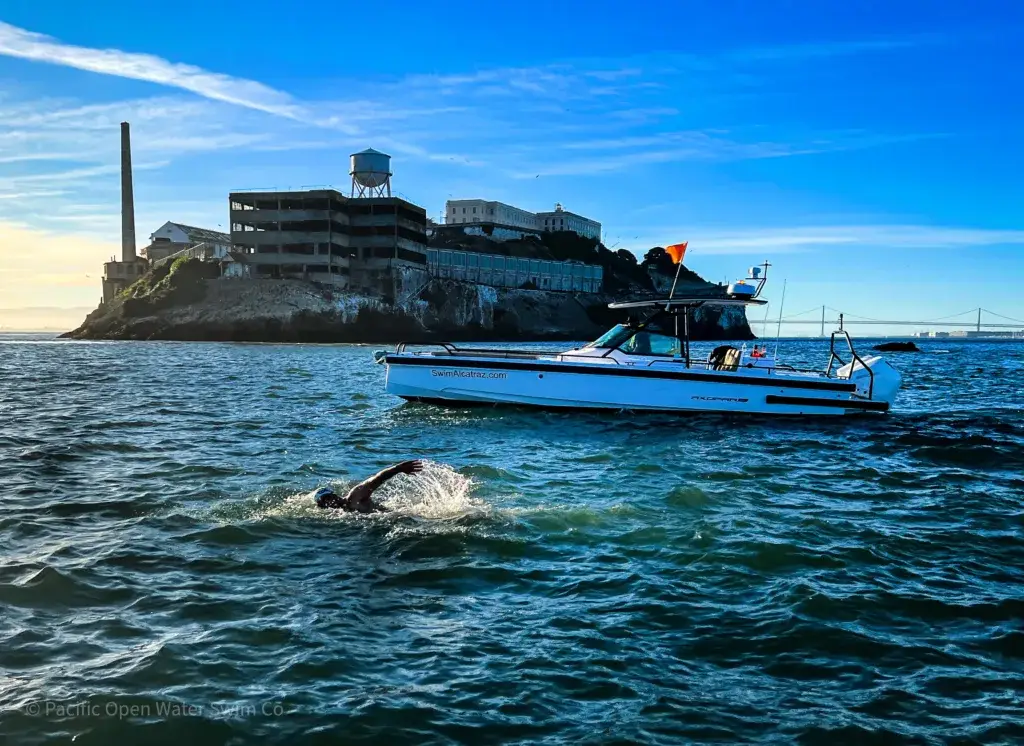
Every attempt is operated by a USCG-licensed captain on modern, comfortable vessels equipped with AIS, radar, and coordinated with the US Coast Guard Vessel Traffic Service, so the movement of commercial ships is managed rather than left to chance. The distance of this swim is only part of the challenge. The real work is staying steady while the Bay and the conditions shift around you, and while commercial shipping dictates when you can continue.
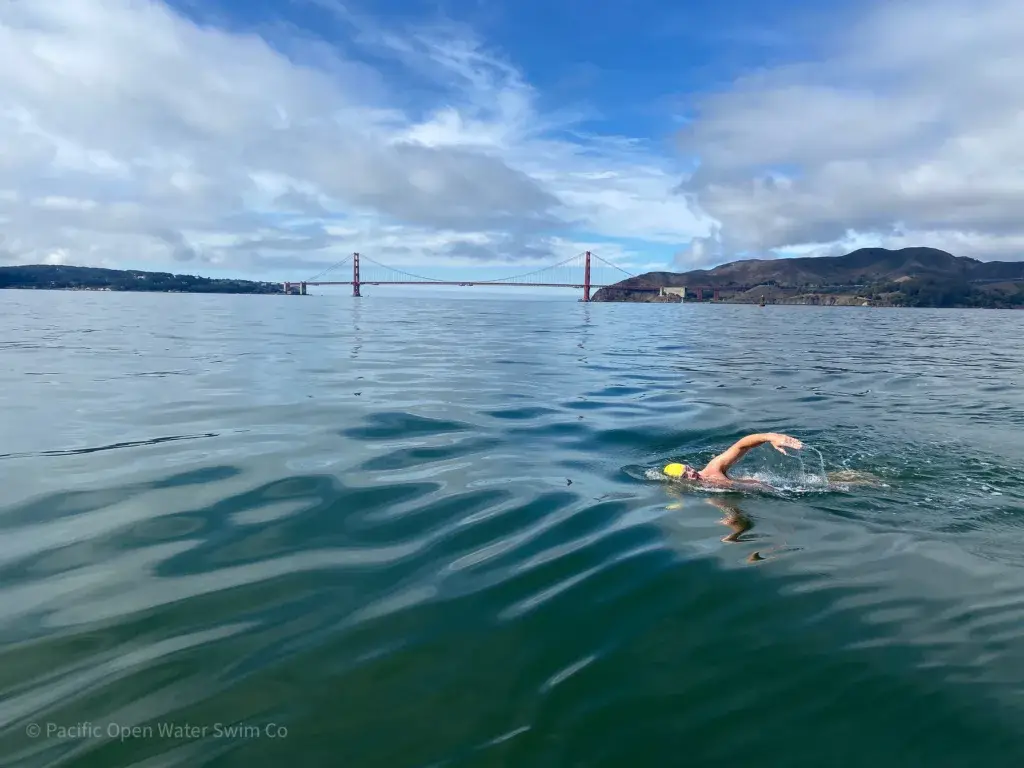
Distance and the route in San Francisco Bay
This is a moderate-distance marathon swim covering about 11 miles (17.7 km) for most swimmers. The minimum swim distance is 10 miles (16.1 km). The route is straightforward in concept. You start on the beach in San Francisco at Aquatic Park, swim out, pass Alcatraz, circle Angel Island, pass Alcatraz again, and finish on the same beach. The execution is anything but simple. The line is clean on a chart and a complex logistical challenge in the maritime environment, which San Francisco Bay is known for, every time we attempt it.
Difficulty and Conditions:
- 10 miles, 16.1 km minimum
- About 11 miles, 17.7 km for most attempts
- Cold water in the low to mid fifties, depending on season (see below)
- Cross currents on the outbound and the return
- Three commercial shipping channels crossed twice
- Ferries and commercial traffic always have priority
- Strong tidal influence that shapes both direction and speed
- Limited monthly tide windows that permit a safe attempt
SF Water Temperature: San Francisco’s cold water stays in the mid-fifties ( 12 to 14.5°C) for most of the season, rises into the low sixties (15 to 16.5°C) in the fall, and for those who live more fully, settles into the low fifties (10 to 11.5°C) from December through mid-March. Learn more here.
Tides, timing, and swim direction
We set the start time around your pace and the tide, not convenience. Only a few days each month line up for this route, and the window shifts daily. Most workable starts fall between 12 and 3 AM. The tide sets the schedule, not us.
There is a narrow tidal window that makes this course work. If anything slips, hours and some very tough swimming can be added before we reach the opening at Aquatic Park. This route is unforgiving if we get delayed, or if you cannot maintain the pace you identified during registration. When the timing shifts and things do not go your way, your crew, your preparation, your ability to grind through it, and a bit of luck decide how the day ends.
The course can be swum clockwise or counterclockwise. The prevailing currents determine the direction on the day of the swim. We choose the line that gives you the best shot at a clean outbound, a controlled return, and the shortest possible time.
Who is this marathon swim for?
This route is for experienced marathon swimmers who can hold a steady pace for 6-plus hours in the cold water of San Francisco Bay and manage themselves when conditions change. This should not be your first marathon swim. This is a traditional marathon swim governed by NCOWSA rules, meaning a porous textile suit and no wetsuits. It stands on its own as a serious challenge. However, many swimmers use it as preparation for longer cold water swims that require endurance, strength, steady pacing, and flexibility during long-duration efforts.
Our piloting authority in San Francisco and California
Pacific Open Water Swim Co. is the primary marathon swim escort provider in San Francisco Bay and Northern California, piloting more Round Trip Angel Island attempts than any other organization. As of December 2025, we have piloted more than 410 successful marathon swims since 2017. Across California, we also pilot three Lake Tahoe marathon swims through SwimTahoe.com, the 25.1 mile (40.3 km) Monterey Bay, and the 12.2 mile (19.6 km) Santa Barbara Channel (Anacapa to mainland) and other swims on occasion. San Francisco Bay has four additional marathon routes, including the 21 mile (33.8 km) Circumnavigation of San Francisco, a NCOWSA Swim of Distinction.
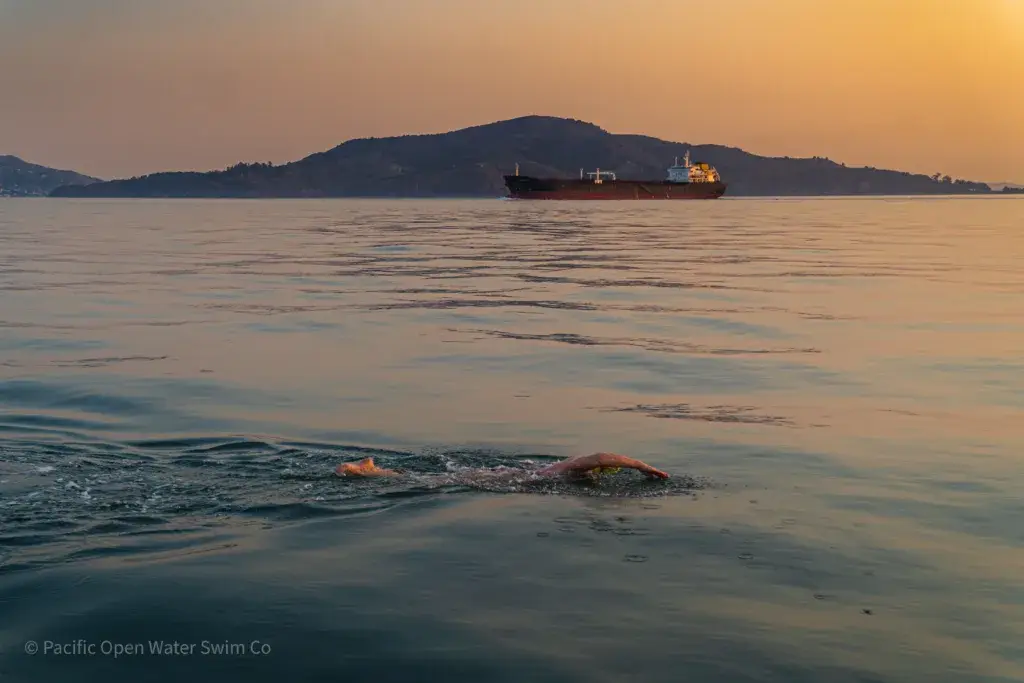
Our Round Trip Angel Island piloting record
Since 2017, we have piloted about two of every three successful Round Trip Angel Island attempts, completing nineteen of every twenty. As of December 2025, we have piloted 61 successful RTAI swims with an average time of 6 hours and 28 minutes. The fastest we have piloted is 4:33:49 by Lura Wilhelm in 2023. We have also piloted a double RTAI, out around and back, then out around again, completed by Lisa Yamamoto in 2024 in 12:00:36, clockwise in 5:16:14, and counterclockwise in 6:44:22.
Full RTAI results are available here: Northern California Open Water Swimming Association.
The few DNFs tell their own story. Only one was related to ability, when a swimmer did not know their true open water pace and they encountered a current more challenging than they could handle, something we now prevent through more careful vetting. One swimmer exited after 6 hours and 15 minutes to save strength for an upcoming channel attempt and did not want to overtax themselves. One was due to vertigo. Another involved a separate medical concern. None were course failures or logistical errors. They reflect how prepared our swimmers are when they arrive for this route and the strength of the planning behind each attempt.
Swims piloted by others average nearly 30 minutes longer, underscoring how sensitive this route is to timing, route selection, and real-time decisions. When you time or pilot this course poorly, minutes become extra hours and extra miles. The Bay makes you pay for every mistake. When the plan holds, and your pilot builds in contingencies, the route stays efficient and controlled even when conditions and vessel traffic seem to act against you.

Planning and piloting this San Francisco Bay marathon swim
After your ability, experience, and fitness, success depends on planning and piloting. We evaluate and plan the timing, tides, and traffic windows with your pace in mind. Each attempt involves both the flood and ebb currents, so setting the outbound and return lines at critical points along the course is paramount. The swimmer handles pace. Your crew handles feeds and your needs. The pilot handles the course, the traffic, and a nonstop evaluation of how the swim is unfolding, what must occur next, and what cannot be allowed to happen. During the attempt, safety, disciplined judgment, and steady anticipation anchor our role in your success.
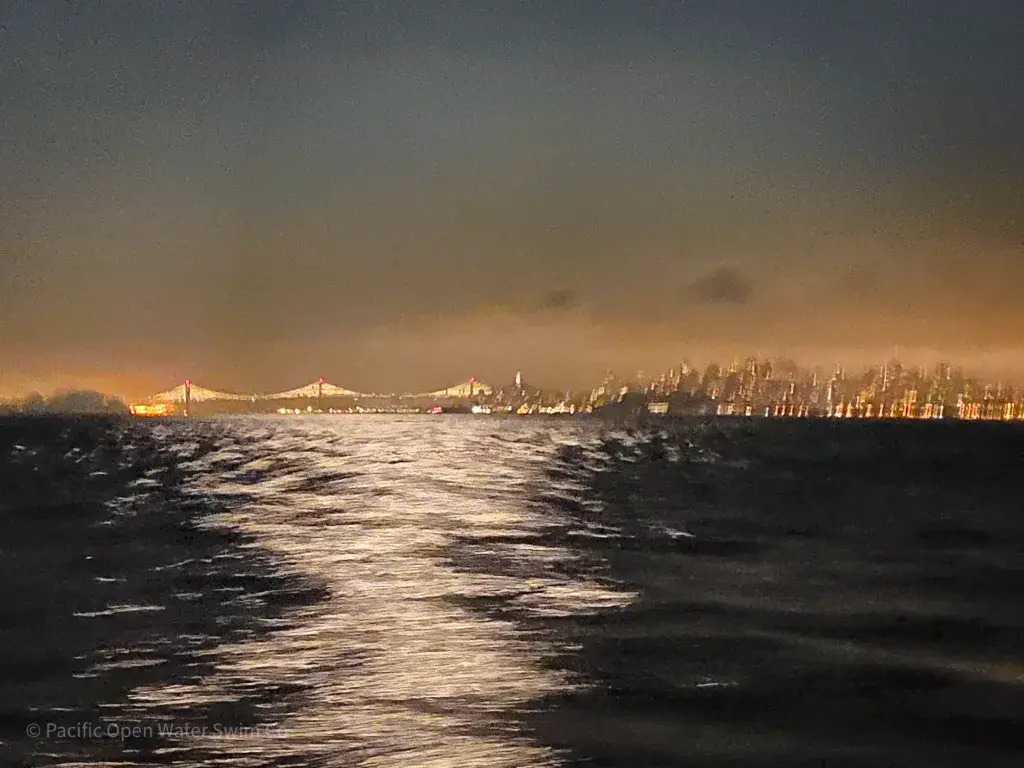
Safety, escort vessel, tracking, and USCG coordination
You swim with a licensed captain on a dedicated, modern escort vessel with a head (bathrooms, with a sink and electric-flush toilets) for crew use. Before, during, and after every swim, we coordinate with USCG Vessel Traffic Service, track and communicate with bar pilots on all deep draft commercial traffic, monitor scheduled ferry routes, respond to recreational vessel traffic, watch weather, actual current, and sea conditions, and maintain safe passage throughout the attempt. At the same time, we work with your crew, assist the observer, monitor your pace, and stay aware of your physical and mental condition. You are expected to follow the pilot’s instructions on positioning, respond to your crew’s direction, and make any adjustments required as the swim unfolds.
Every marathon swim includes our custom live GPS tracking system, built over six years of development with ZeroSixZero and tuned for the conditions we operate in. It provides stable, real-time tracking across all our routes through our 5G and Starlink-connected vessels, so friends and family can follow your progress in their WhatsApp groups and know precisely when to head to Aquatic Park to catch your finish and celebrate on the beach with an Irish Coffee.

Preparation and training for cold water swims
Swimmers must know their pool pace when registering. Every swim we plan is built on the 100 yard pace you can hold indefinitely. The easiest way to calculate it is during a normal midweek workout of two to three thousand yards. When you finish, time a four- or five-hundred-yard warm down with light pushes on the turns and no rests. Divide it by the number of hundreds (4 or 5 in this example), and there you go. Real world open water conditions can shift your sense of pace without you noticing, and our planning tools rely on the pool pace as the baseline. We need an honest number to plan your swim. Get it wrong and you are the one who pays for it in the Bay.
A solid and knowledgeable crew is required for marathon swims. We cannot overstate the value of a crew that knows your swimming and understands the demands of marathon/ultra-marathon swims. Please arrive organized. Do not bring feeds in a paper bag or ask us to toss a bottle from the deck. Your feeds should be planned on paper, ready to dispense, labeled clearly, and handled by someone who knows how to support a swimmer both when things go well and when they turn south.
This is not the time to test things
In our experience, swimmers should never introduce anything new with feeds, bottles, systems, or timing during a marathon swim attempt. Long training swims are where the swimmer and crew test what works and what fails. There is too much time, effort, and money at risk to experiment on the day. Test your systems, your nutrition, and your gastrointestinal fortitude long before you arrive on the boat. This course is tested often and is not the place to learn that open-top bottles do not belong in salt water or that your magical protein carbo pumpkin spice matcha mix tastes great on land and turns criminal somewhere around hour four.

Many swimmers use this course as a qualifier for the English Channel, six hours at or below 60°F (15°C), or for other ultra-marathon qualifiers with timed cold water requirements. The distance and the conditions here make it a reliable setting for that type of test most of the year.
RTAI is also a strong training swim for longer-duration courses worldwide. The cold water, the time in the water, and the shifting tide help lock in acclimation for both the swimmer and the crew. This route gives a clear sense of where your pace, endurance, feed timing, communication, and cold tolerance stand before moving on to longer and typically more expensive goal swims. San Francisco is, by modern standards, a quick flight from anywhere in North America and a great place to spend a weekend, too. Fly in and swim!
Booking your Round Trip Angel Island swim
If you believe you are ready for this swim, reach out via the button below, fill out the Book-A-Swim form, and share your goals, availability, pace, and experience. We will review everything and work with you to find the right window. As should be clear by now, preparation and timing are part of the route and what gives this swim its reputation. You will earn this one, and when you do, the next question usually becomes which Bay swim you want to chase next, such as 4 Islands or the 21 mile (38 km) Circumnavigation of San Francisco.